

Best Executive Search Firms for Confidential Succession Planning: Bench vs Market
CEO turnover keeps breaking records. In 2025, 234 chiefs left the corner office—21 percent above the eight-year average. Still, 30 percent of public-company boards have no named successor, and another 10 percent admit they’re unsure.
A leak-proof CEO succession plan is now table stakes. This guide ranks the firms best equipped to keep your search under wraps, shows when to decide between an internal heir and the open market, and arms you with the questions that keep activists—and headlines—at bay.
The quick answer: who’s best for confidential CEO succession?

We assessed more than two dozen search firms against an eight-factor, board-level scorecard. Six stood out:
| Firm | Where it shines most |
| Spencer Stuart | Public-company CEO and board succession |
| Egon Zehnder | Long-horizon or family-enterprise hand-offs |
| Russell Reynolds | Assessment-rich, global mandates |
| Heidrick & Struggles | Transformation searches and interim cover |
| Korn Ferry | Integrated search, assessment and pay data |
| SPMB | Tech, innovation and founder-to-scale moves |
No single firm fits every brief.
- Want quiet continuity? Egon Zehnder.
- Planning a radical pivot? Heidrick & Struggles.
- Passing a tech baton? SPMB.
Each can benchmark your internal talent against the market; ask every one of them to show its confidentiality protocol and verifiable outcomes.
Bench vs. Market, Part 1: When the bench already has your next CEO
Sticking with an insider is often the smartest play. In 2025, 60 percent of S&P 1500 CEO appointments came from the internal bench, according to Spencer Stuart. Those handovers typically closed faster and with less share-price turbulence than outside hires.
Why boards choose continuity:
- Context is instant. A prepared COO already knows which levers move revenue, which stakeholders resist change, and which crisis plans sit in the drawer, so Day 1 risk stays low.
- Share-price steadiness. Analysts tend to reward predictable performance, and an internal promotion sidesteps the uncertainty premium that can follow an outsider.
- Retention of critical talent. Naming the heir early keeps lieutenants focused on results, not recruiters.
- Lower direct cost. Building the bench avoids the one-third-of-cash fee, plus the roughly four-month cycle of a confidential external search, though outside benchmarking still matters for pay and validation.
Promote from within when strategy is working, culture is your moat, and at least one leader can meet the future-state brief after measured development. The next subsection flips the script and highlights the signals that tell a board it is time to open the market.
Bench vs. Market, Part 2: When the outside world holds the answer
Continuity calms investors until strategy stalls. External hires made up 40 percent of S&P 1500 CEO appointments in 2025, according to Spencer Stuart, as boards sought leaders who could write a new playbook rather than protect the old one.
Signals you need fresh DNA:
- Growth plateau. Sales stay flat or margins erode while rivals out-innovate you.
- Rulebook reset. New regulation or technology overturns core assumptions.
- Activist heat. Shareholder letters rarely ask for “more of the same”; they want a CEO who can explain change on Day 1.
An outside slate also carries higher execution risk. Externally hired CEOs are 84 percent more likely to be replaced within their first three years than those promoted from within, according to SIGMA Assessment Systems. Still, the external view benchmarks compensation and curbs loyalty inflation.
Costs are real: retained-search fees hover near one-third of first-year cash and the average executive search runs about 117 days before an offer. Yet when the brief is reinvention, that spend is smaller than a mis-hire that can shave billions off market cap.
Bottom line: if the roadmap needs a jolt, stakeholders want a new story, or no insider fits tomorrow’s spec, open a confidential CEO succession search. SPMB, for example, says it closes hundreds of C-level searches a year and that its proprietary data taxonomy and 40-year network identify comparable executives quickly.
Bench vs. Market, Part 3: Why the sharpest boards run both tracks
More public companies now run a dual-track, confidential CEO succession. Spencer Stuart notes that among boards with a formal process for reviewing internal candidates, 51 percent benchmark those leaders against external contenders.
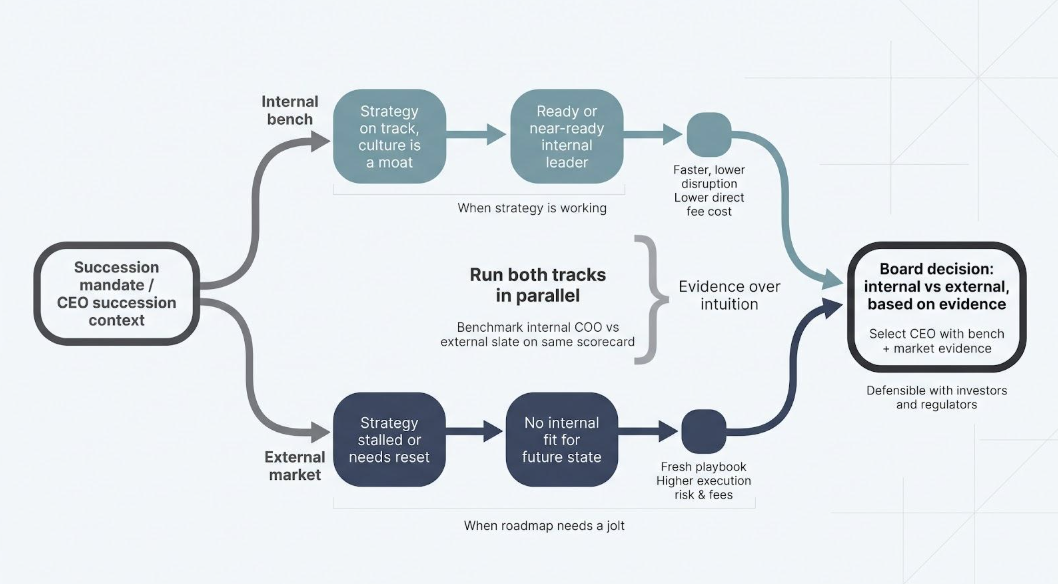
A hybrid mandate delivers three advantages:
- Evidence over intuition. The same scorecard tests your rising COO against external finalists. If the insider still wins, directors can tell investors, “We compared her to 12 public-company CEOs, and she topped the list.”
- Time insurance. While the COO completes a 12-month readiness plan, the search partner quietly warms an external slate. If the insider falters, a market-ready option is days, not months, away.
- Process credibility. Regulators, analysts, and employees see diligence, not haste. Research from Russell Reynolds Associates shows that internally promoted CEOs serve an average of 8.7 years compared with 7.3 years for external hires; a dual-track search supplies the evidence needed to back a long-term internal choice.
Want that two-lane discipline? This step-by-step CEO succession planning framework covers the scorecard, timeline, and communication plan.
The strongest negotiating position is to have verified options, inside the building and out.
How we evaluated the firms
Scoring search partners for confidential CEO succession is a forensic exercise, not a beauty contest. We used one firm filter: only evidence a board can verify (SEC filings, public appointments, or redacted client letters) counted.
Each firm had to show recent CEO or board work, publish a confidentiality protocol, and supply data for at least half of our scorecard. Those that passed were rated on eight weighted criteria (0–5 points each):
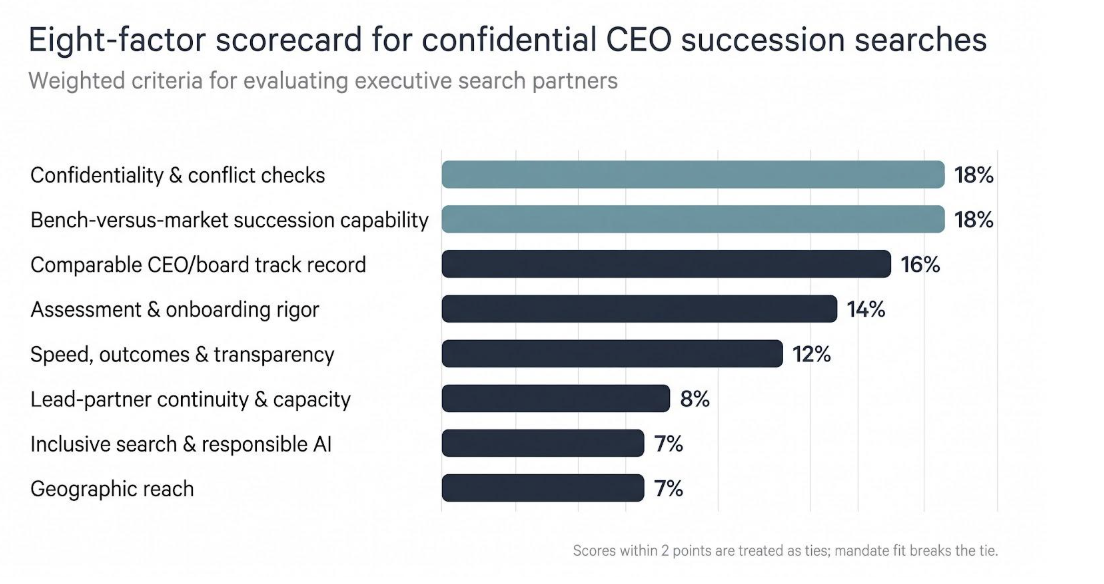
| Criterion | Weight |
| Confidentiality & conflict checks | 18 % |
| Bench-versus-market succession capability | 18 % |
| Comparable CEO/board track record | 16 % |
| Assessment & onboarding rigor | 14 % |
| Speed, outcomes & transparency | 12 % |
| Lead-partner continuity & capacity | 8 % |
| Inclusive search & responsible AI | 7 % |
| Geographic reach | 7 % |
Scores within two points are treated as ties; the better mandate fit wins the tiebreak. We flag self-reported metrics until a board reference or public document confirms them.
Feel free to drop this framework straight into your next RFP. Its purpose is to reward evidence, not slide decks.
The field at a glance
Here’s a cheat sheet to bring to your next nom-gov meeting on confidential CEO succession:
| Firm | Best fit | Score* | Verifiable proof point |
| Spencer Stuart | Public-company CEO and board searches | 93 | Annual S&P 1500 transition study; multi-year CEO-retention research |
| Egon Zehnder | Long-horizon, family and cross-border succession | 92 | One-firm partnership; 1,200+ CEO appointments in five years |
| Russell Reynolds | Assessment-heavy global mandates | 91 | Governance analytics; Global CEO Turnover Index benchmarks |
| Heidrick & Struggles | Transformation plus interim leadership | 89 | Dedicated interim practice; 2025 take-private scale-up filing |
| Korn Ferry | Integrated search, assessment and pay data | 88 | World’s largest proprietary comp database (SEC Form 10-K) |
| SPMB | Tech, innovation and founder transitions | 84† | 40-year track record with venture- and PE-backed companies; partner-led delivery |
*Scores reflect the eight-factor rubric weighted toward confidentiality, bench–versus-market capability, and outcome evidence.
†SPMB’s rating rises to about 91 for pure-play tech or growth-stage mandates where sector fit carries extra weight.
Next: firm-by-firm profiles explaining why each shines, where to press for detail, and how to match strengths to your brief.
SPMB: Best for technology and product-driven succession
For confidential CEO succession in venture-backed or public tech companies, SPMB is the boutique many boards call first. The firm describes 40 years of building executive teams for venture- and private-equity-backed companies and still fields partner-led teams.
SPMB website homepage (screenshot)
What sets SPMB apart is its “living map” of venture and private-equity operators: an always-current view of founders, scale-up CEOs, and product leaders who can professionalize without killing culture. Late-stage boards value that blend of builder DNA and operational rigor.
Due-diligence checkpoints:
- Off-limits map. A tight focus on the tech sector can block candidates who recently moved between portfolio companies.
- CEO-specific metrics. The firm reports closing hundreds of C-level searches a year; ask for CEO-only completion and 12/24-month retention data.
- Global reach. Coverage outside North America comes via partner travel or network alliances—fine for most tech briefs, but clarify expectations if your mandate spans APAC or EMEA.
Press for those answers and you will secure a partner who already knows where tomorrow’s technologists are building today.
Spencer Stuart: Best for public-company CEO and board succession
When a confidential CEO succession will hit headlines, many Fortune 500 boards turn to Spencer Stuart. In the past five years the firm has advised on 52 S&P 500 CEO appointments, the largest share in that index, and its annual S&P 1500 CEO Transition Study is required reading for directors.
Research power turns into process discipline: project codenames, restricted data rooms, and written consent before any back-channel reference call. Consultants benchmark internal contenders and an external slate on the same scorecard, letting your nom-gov committee defend either path under investor or regulator scrutiny.
Watch-outs: scale can create conflicts. A broad client list means a long off-limits map, so ask for it early. Fees sit at the top of the market, yet most Fortune-level boards view the premium as insurance against a failed handoff.
Choose Spencer Stuart when markets, media, and regulators will grade your succession homework line by line.
Egon Zehnder: Best for long-horizon and family-enterprise succession
When a confidential CEO succession spans borders or generations, Egon Zehnder’s one-firm partnership stands out. Consultants share profits globally, so the Paris partner can brief the São Paulo team, a critical benefit when a family business needs a seamless hand-off.
Evidence of fit: the firm has completed 1,200+ CEO appointments in the past five years and operates 70 offices across 37 countries (company data, 2026). Its succession audits benchmark internal talent years before a vacancy, flag development gaps, and map external prospects who match the culture. Boards receive a living plan, not an eleventh-hour scramble.
Confidentiality runs deep. All search data sits on a single, role-based platform, and every candidate signs a mutual NDA before references begin. Because partner books overlap, the off-limits list is often shorter than those of multi-brand networks; ask for a current map to confirm.
Trade-offs: the deliberate process can feel unhurried, so agree on milestones if activist pressure looms. While the global reach is wide, smaller U.S. cities may require partner travel, so plan budget and timeline accordingly.
Choose Egon Zehnder when legacy, continuity, and cross-border complexity outrank raw speed on your scorecard.
Russell Reynolds Associates: Best for assessment-intensive global succession
When a confidential CEO succession hinges on hard data, Russell Reynolds Associates (RRA) is the numbers-first choice. Its proprietary Leadership Span™ toolkit, used in 7,500+ senior assessments last year, measures learning agility, strategic DNA, and culture fit. Finalists receive a data-rich profile that highlights strengths, derailers, and onboarding needs, giving compensation and HR committees a running start.
Governance analytics deepen the rigor. The firm’s Global CEO Turnover Index, which now tracks more than 4,000 CEO exits across 20 sectors, shows where comparable leaders thrive or stall; those insights shape the candidate spec before the first outreach email leaves the building.
Confidentiality is enforced through a single-tenant client portal with role-based permissions and an immutable audit trail that meets ISO 27001 and SOC 2 controls. Still, ask how many active searches your named partner is handling; the firm moves quickly, and capacity varies by quarter.
Choose RRA when the board wants evidence over anecdotes and prefers the onboarding plan half written before the offer goes out.
Heidrick & Struggles: Best for transformation plus interim leadership
When a turnaround cannot wait, Heidrick & Struggles offers a two-step fix for confidential CEO succession: an on-demand bench of interim leaders and a classic retained search that delivers a long-term hire.
Numbers behind the promise: SEC filings show $162,000 average revenue per executive search in 2024, and the firm reports that demand for interim C-suite leaders is up 151 percent since 2021. That scale fuels process strength, with market mapping in days, a qualified short list in about four weeks, and a bridge executive who can steady the ship tomorrow.
Confidentiality stayed tight after the 2025 take-private; a single-tenant client portal now uses role-based access controls and real-time activity logs. Still, ask how recent acquisitions may have changed consultant teams or expanded the off-limits list.
Choose Heidrick & Struggles when the board needs change fast but will not risk a rushed permanent hire.
Korn Ferry: Best for integrated search, assessment and pay data
When a confidential CEO succession touches every lever of talent strategy, Korn Ferry’s scale becomes a real advantage. The firm pairs a global search practice with its proprietary pay database covering 25 million employee records across 150 countries (SEC Form 10-K, 2026). The same team that sources your new CEO can benchmark incentives, model equity, and design a first-year development plan, so you avoid hand-offs to outside vendors.
How scale speeds execution: consultants pull real-time comp data to close offers faster, and Korn Ferry Assess™ benchmarks feed straight into onboarding playbooks. You get one data spine from prospecting to pay package.
Confidentiality meets enterprise standards. A single-tenant cloud portal uses dual-factor authentication, and every candidate report carries a user-specific watermark. Breadth can create off-limits friction; the firm works with 11,000+ clients annually, so request a blocked-company map early.
Choose Korn Ferry when you want one platform, one team, and one dataset from first outreach to signed contract.
What “confidential” really means in a CEO search
For confidential CEO succession, discretion is a full operating system, not a courtesy title. It protects market value, candidate reputations, and board credibility from leaks that can move the share price overnight.

Real discretion starts inside the boardroom. A three-person nom-gov working group owns the mandate, and every file sits behind role-based permissions. Your search partner mirrors that rigor with project codenames, need-to-know access, and reference calls that require written consent, all in line with the AESC Candidate Bill of Rights and ISO 27001 controls.
Before you sign a retainer, ask the firm to show a redacted audit log from a live engagement and to walk through its breach-response playbook, including time-to-notification commitments (best practice: within 24 hours).
Use this 10-point checklist as a non-negotiable bar:
- Board committee, never management, owns the engagement.
- Project codename and segmented file permissions from day one.
- Mutual NDAs before any identifying information is exchanged.
- Zero outreach via employer channels.
- Written candidate consent before each reference, including back-channels.
- Secure portal with individual watermarks and immutable audit logs.
- Documented data-retention and deletion policy (for example, purge after 24 months).
- Breach-notification SLA of 24 hours or less and a tested mitigation plan.
- Up-front off-limits map to surface conflicts early.
- Pre-approved communications protocol if a leak occurs.
Hold every provider to this list and leaks stay contained; your timeline and valuation stay intact.
What a confidential CEO search costs and how long it really takes
Budget comes first. You should expect a retained search to run one-third of the new CEO’s first-year cash compensation, plus expenses (an industry ratio confirmed in Korn Ferry’s 2026 Form 10-K). Coaching or relocation can raise the bill, but the one-third benchmark still holds for confidential CEO succession.
Time is the second currency. Clockwork Recruiting’s dataset of 100,000+ retained searches shows an average close in 117 days. Add notice periods or visas and the new leader may not take the chair until month eight.
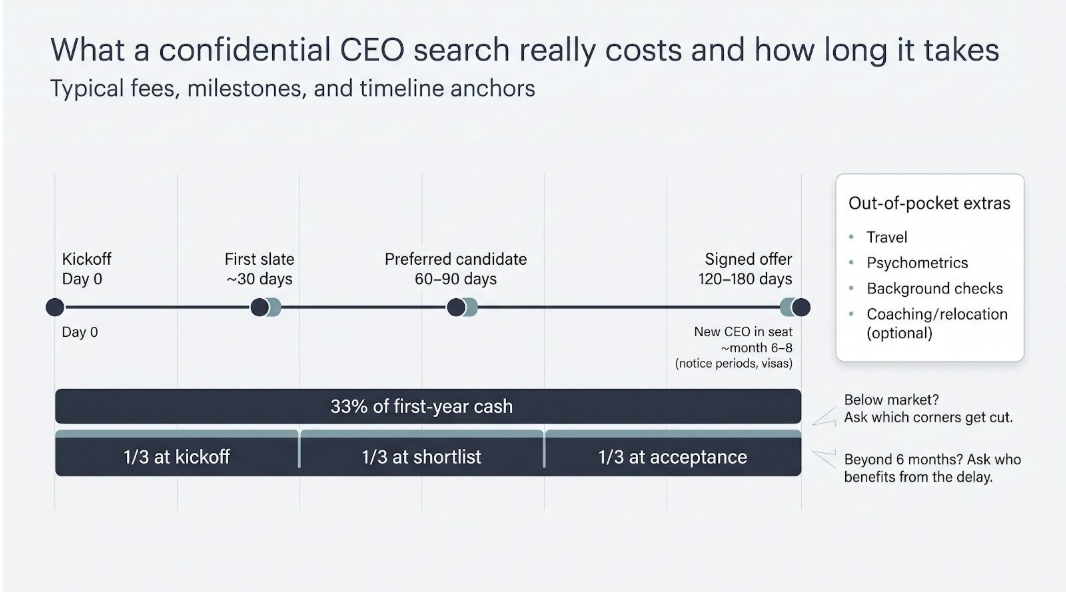
Speed flexes with your decisions. Want a finalist slate in 30 days? Lock the spec, clear conflicts, and grant fast-track approvals. Slow committee turns and even the best firm cannot shrink the calendar.
Quick reference:
- Fees: 33 percent of first-year cash, invoiced in thirds (kickoff, shortlist, acceptance).
- Out-of-pocket: travel, psychometrics, background checks.
- Timeline anchors: 30 days to first slate, 60–90 days to preferred candidate, 120–180 days to signed offer.
If a quote lands far below these norms, ask what corners get cut. If a timeline drifts past six months, ask who gains from the delay; it is rarely the shareholders.
Four trends reshaping succession search
Four forces will shape confidential CEO succession over the next 24 months. Track them early and your board stays ahead; ignore them and you may negotiate from behind.
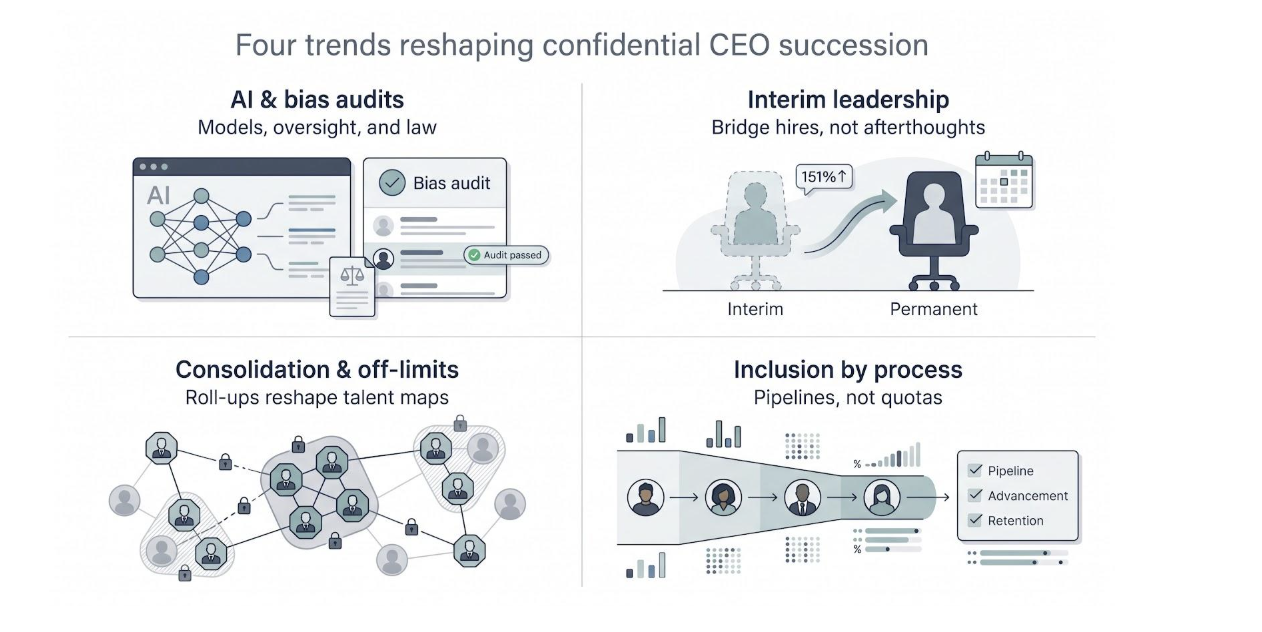
- AI is now table stakes.
Cluen’s 2025 survey shows 91 percent of search firms use large language models for market mapping and candidate summaries. New York City’s AEDT law requires bias audits and candidate notices, while the EU AI Act labels recruitment tools “high risk.” Ask your provider to name its model, audit partner, and human-review checkpoints.
- Interim leadership has gone mainstream.
Heidrick reports a 151 percent jump in interim C-suite demand since 2021. Verify that the interim arm follows the same confidentiality and conflict protocols as retained search, or your leak risk doubles.
- Consolidation changes off-limits math.
Heidrick’s 2025 take-private, plus ZRG and Odgers boutique roll-ups, widened reach and lengthened off-limits lists. Request a post-M&A consultant roster and data-residency map before you sign.
- Inclusion is moving from quotas to process.
Legal challenges trimmed formal targets, yet 58 percent of S&P 500 boards still require diverse slates. Ask for auditable pipeline metrics, such as long-list diversity, advancement rates, and 12-month retention, instead of slide-deck promises.
Ten questions to lock down before you sign a confidential CEO succession retainer
Great pitches charm; great contracts protect. Before the board chair lifts the pen, ask:
- Which target companies are off-limits today, and what share of the market do they cover?
- Who is the named lead partner, and how many active CEO searches are they running right now?
- In the past 36 months, how many comparable CEO mandates closed, and what were the median days to slate, offer, and start?
- Of those hires, what percentage remained in role at 12 and 24 months under the firm’s retention definition?
- Will internal and external candidates be assessed with the same tools, scorecard, and interview depth?
- Which AI systems handle candidate data, where is that data stored, and was a bias audit completed in the last 12 months?
- Show the breach-response playbook: who notifies whom, and within how many hours (SLA)?
- What work will associates handle versus the lead partner, stated in estimated hours or interview count, and can we veto substitutions?
- How does the fee change if we pause, cancel, or appoint an internal candidate? Provide the dollar amounts.
- What post-placement support is included, such as onboarding coaching, 90-day check-ins, and replacement-guarantee timing?
Frequently asked questions
Who are the Big Five executive-search firms?
Korn Ferry, Heidrick & Struggles, Spencer Stuart, Russell Reynolds Associates, and Egon Zehnder. Together they account for most global retained-search revenue, yet each excels in different confidential CEO succession contexts covered above.
What percentage do retained search firms charge?
About 33 percent of the new CEO’s first-year cash compensation, invoiced in thirds. Multiple SEC filings, including Korn Ferry’s 2026 Form 10-K, confirm this ratio.
How long does a CEO search take?
Plan on 4–6 months from kickoff to signed offer. Clockwork Recruiting’s dataset of 100,000+ searches shows a 117-day average. Faster cycles often mean corners cut on benchmarking or references.
Is an internal CEO usually better than an external hire?
It depends on strategy. In 2025, 60 percent of S&P 1500 appointments were internal and 40 percent external, according to Spencer Stuart. Benchmark both tracks before you decide.
Can the same search firm assess internal candidates?
Yes. Leading firms apply one scorecard to insiders and outsiders, giving directors an apples-to-apples view of readiness and risk. Insist on that parity in the engagement letter.
How do confidential searches prevent leaks?
By using role-based portals, project codenames, written-consent references, and immutable audit logs. Ask the firm to show a redacted audit trail before you sign.
What is an off-limits policy?
A long-term client agreement that bars the firm from recruiting talent away from those companies. Request the off-limits map at the start of a confidential CEO succession to avoid late surprises.
Should the board appoint an interim CEO during the search?
Often, yes. Interims buy time when succession starts under pressure; Heidrick reports a 151 percent rise in interim C-suite demand since 2021. Hold interim suppliers to the same confidentiality and conflict standards as the retained search.
Conclusion
Confidential CEO succession is won before the search starts. Decide whether the bench can meet the future-state brief, run an external benchmark even if you expect to promote from within, and choose a search partner whose strengths match the mandate: public-company scrutiny, cross-border continuity, assessment depth, transformation, integrated pay data, or tech-sector reach. Then put confidentiality, conflicts, fees, and timelines in writing before the retainer is signed. Hold every provider to diligent confidentiality, evidence-based benchmarking, and verifiable outcomes, and your board will navigate confidential CEO succession without leaks, surprises, or valuation hits.